
Steel Ball Selection for Check Valves and Needle Valves
In check valves and needle valves, the steel ball is small but decisive. It is the sealing or shut-off element that stops backflow, holds pressure, or meters flow, and the wrong material or tolerance turns a working valve into a leak source. This technical guide explains how to match ball material, hardness, corrosion resistance and precision grade to valve type, fluid service and temperature, using application evidence drawn from oil, gas and petrochemical valve trim — including wet gas and mildly corrosive fluid duty between 0 °C and 200 °C under moderate pressure.
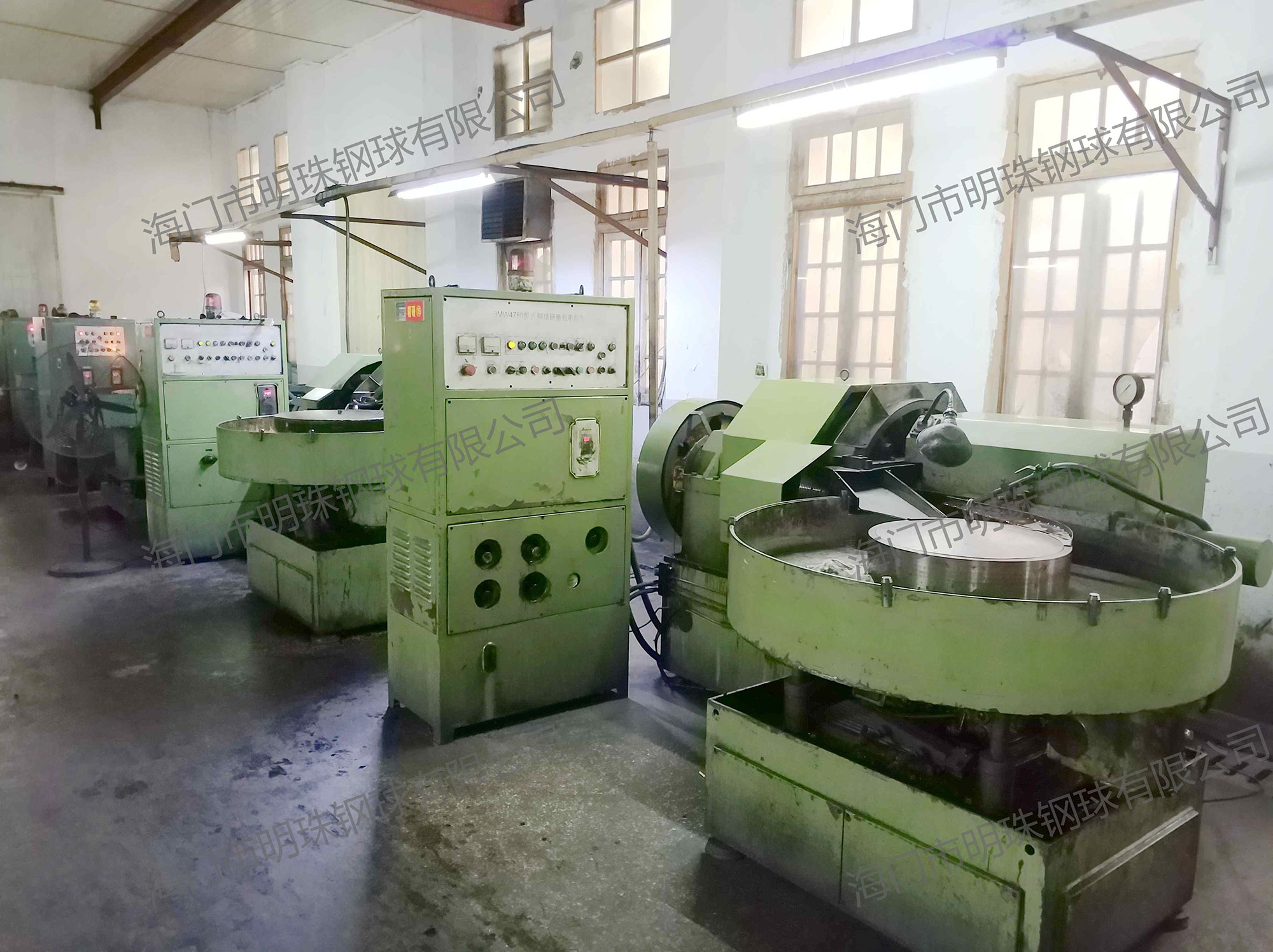
Final polishing stage in precision steel ball production — surface finish directly affects sealing performance in check and needle valve seats.
Problem Definition: Why Ball Selection Decides Valve Reliability
A ball valve or needle valve does not fail because the body cracked. It usually fails because the spherical element — the ball that seats against a ring or orifice — stopped sealing. That failure rarely comes from a single dramatic cause. It comes from a mismatch between the ball and its service condition.
Four mismatch patterns account for most sealing problems in check and needle valve applications:
- Hardness mismatch. A ball that is too soft deforms under repeated seating load and loses its sealing line. A ball that is too hard but brittle can chip at the seat contact zone.
- Corrosion mismatch. A carbon or low-alloy ball in mildly corrosive or wet-gas service develops pitting on the sealing surface, and the seal leaks through the pits.
- Tolerance mismatch. A commercial-grade ball in a needle valve with a tight orifice creates inconsistent metering and premature seat wear because diameter variation scatters the flow curve.
- Traceability mismatch. A ball with no material certificate cannot be verified after installation, which is a serious problem in petrochemical, offshore and OEM valve programs that require documented materials.
Each of these is preventable at the selection stage. The rest of this guide converts those four risks into a practical selection sequence.
Industry Background: The Ball Inside the Valve
Steel balls used as valve trim are a distinct subcategory of the broader steel ball market. The global steel ball market is estimated to reach USD 12.91 billion by 2026, with chrome steel balls projected to hold a 45.7% share of the material segment. That dominance reflects the general industrial preference for through-hardened chrome steel where maximum fatigue life matters. Valve trim, however, follows a different logic: sealing and corrosion behaviour usually outweigh pure rolling fatigue life.
Two standards frame the technical conversation. ISO 3290-1:2014 specifies requirements for finished steel balls for rolling bearings and defines accuracy grades from G3 to G700. ASTM A295 covers high-carbon anti-friction bearing steel, the family that includes Grade 52100. Steel balls for bearings and valve trim are classified under HS Code 8482.91 (balls, needles and rollers), a classification that applies across the precision and non-precision segments.
Within valve and fluid control, the dominant industrial setting is oil, gas and petrochemical service. The working profile typically reads: wet gas and mildly corrosive fluids, 0 °C to 200 °C, moderate pressure, and quarter-turn or intermittent actuation. The matched equipment includes floating and trunnion-mounted ball valves, needle valves and check valves. The usual special requirement is a hardened martensitic ball in the HRC 48–55 range with moderate corrosion resistance, and NACE MR0175 optionally specified for sour service.
Understanding where the ball sits inside each valve type is the first step toward selecting it correctly.
Detailed Solution: Matching Ball Specification to Valve Function
Three parameters drive almost every valve-ball selection decision: material hardness, corrosion resistance, and operating temperature. These three are not independent. Raising hardness often trades away corrosion resistance, and raising corrosion resistance often trades away hardness. Selection is the discipline of choosing the right balance for the specific valve and fluid.
Parameter 1 — Material Hardness for the Sealing Surface
For check valves and needle valves in oil, gas and petrochemical service, the reference hardness window for hardened martensitic stainless valve trim is HRC 48–55. Within the available stainless grades, AISI 420C (UNS S42000) is the martensitic stainless ball that hits this window directly: it hardens to approximately HRC 48–55 and provides moderate corrosion resistance.
Two neighbouring grades frame the choice:
- AISI 440C (UNS S44004) hardens to HRC 58–65 with good corrosion resistance. It is harder and more wear-resistant than 420C, and is used in high-precision valves and bearings where abrasive wear and corrosion both matter. The trade-off is higher processing cost and a requirement for controlled hardening and passivation.
- AISI 304 is austenitic and non-hardenable at approximately HRB 80. It is far better in general corrosion resistance, but it cannot hold a high-load sealing edge the way a martensitic ball can. Its proper role in valve service is corrosion-critical, low-wear duty such as food, pharmaceutical and decorative applications.
The practical rule for check and needle valves is straightforward: if the ball carries a sealing load against a seat, use a hardenable martensitic grade such as 420C or 440C. If the ball is a corrosion-resistance element with little mechanical load, austenitic 304 or 316 is the better engineering fit.
Parameter 2 — Corrosion Resistance for Mildly Corrosive Fluids
Valve trim balls in petrochemical service often face mildly corrosive fluids: wet gas, light hydrocarbons with trace moisture, and diluted chemical streams. The selection logic depends on the chloride and acid content of the fluid.
Austenitic 316 stainless contains 2–3% molybdenum and 10–14% nickel, giving it a Pitting Resistance Equivalent Number (PREN) of roughly 23–28. That is meaningfully better than 304, which contains no molybdenum and reaches PREN of roughly 18–20. In chloride-bearing or chemical service, 316 resists pitting and crevice corrosion that would degrade 304.
Martensitic 420C and 440C are less corrosion-resistant than 316 in aggressive chloride media, but they are much harder. In mildly corrosive service — where the fluid is not strongly acidic or high-chloride — 420C and 440C balance hardness with adequate corrosion resistance. For severe chemical service where strong acids or high chlorides are present, higher-alloy materials enter the picture, including duplex stainless (UNS S31803/S32205) and Hastelloy C-276 (UNS N10276). Duplex offers roughly double the yield strength of 316 and PREN in the 34–38 range. Hastelloy C-276 contains 15–17% molybdenum plus 3–4.5% tungsten, giving PREN around 69, and is used where 316 will not survive.
Practical selection boundary: for mildly corrosive fluid service between 0 °C and 200 °C at moderate pressure — the working profile typical of petrochemical check and needle valve trim — hardened martensitic stainless such as 420C is usually the balanced choice. For wet gas with elevated chlorides or sour service, move to duplex or Hastelloy and confirm NACE MR0175 compliance.
Parameter 3 — Operating Temperature Range
Across the typical valve-trim working window of 0 °C to 200 °C, the hardened martensitic grades hold their hardness and sealing geometry well. As service temperature rises toward the upper end of that band and beyond, two effects matter:
- Austenitic 304 and 316 retain their corrosion resistance but stay soft, so they remain sealing-limited in high-load seats.
- For applications extending above conventional valve-trim temperatures, high-speed tool steel grades enter consideration. AISI M50 (UNS T11350, AMS 6490) is a high-speed molybdenum alloy tool steel that hardens to HRC 62–66 and retains hardness and strength at elevated temperatures. It is used in aero-engine main-shaft bearings, high-speed spindles and high-temperature bearing applications, and it requires tight process and heat-treatment control plus full traceability.
For valve trim specifically, matching the ball grade to the actual maximum continuous operating temperature — not the occasional peak — is the correct engineering practice.
Step-by-Step Breakdown: A Valve Ball Selection Workflow
The following sequence converts the three parameters above into a repeatable selection decision for any check valve or needle valve project.
Step 1 — Identify the Ball Function Inside the Valve
Confirm whether the ball acts as a spring-loaded check element, a needle-valve metering element, or a shut-off element in a floating or trunnion-mounted ball valve. In a check valve, the ball is normally spring-loaded and lifts against a seat, then returns to seal. In a needle valve, the ball often works with a stem tip to throttle flow. In a machined drilled ball used in specialised ball valves, the ball may itself carry a through-hole for flow passage.
Step 2 — Define the Fluid and Temperature Window
Record the fluid chemistry (chlorides, acids, moisture), the maximum continuous operating temperature, and the pressure class. For petrochemical hydrocarbon and wet gas service, the common working profile is 0 °C to 200 °C at moderate pressure. This step sets the corrosion requirement and the temperature-driven hardness limit.
Step 3 — Select the Material Grade
Apply the trade-off logic:
- Hardness-dominant, mildly corrosive: 420C (HRC 48–55).
- Hardness plus better wear resistance: 440C (HRC 58–65).
- Corrosion-dominant, low mechanical load: 304 or 316 austenitic stainless.
- Severe chloride or acid: duplex 2205 or Hastelloy C-276.
- Elevated temperature: M50 high-speed tool steel.
Step 4 — Set the Precision Grade
Precision grade controls diameter variation, sphericity and surface finish. Per ISO 3290-1:2014, grades run from G3 to G700, and commercial-tolerance balls sit at G100–G1000 while precision balls sit at G3–G25. For metering needle valves, tighter grades such as G10 or G25 reduce flow scatter and extend seat life. For load-bearing check valves, a mid-range grade is often sufficient.
Step 5 — Specify Geometry and Features
If the application needs a mounting or flow feature, the ball becomes a custom part:
- Drilled balls add a precision through-hole or tapped hole for assembly or flow passage. Hole location tolerance is typically held to drawing, for example ±0.05 mm or better.
- Non-standard sizes are made to customer-specified diameter, tolerance, material or feature when a standard inch or metric size does not exactly match the design.
- Hollow balls are shell-formed and can be roughly 40–70% lighter than solid balls of the same diameter, which is useful where mass reduction matters.
- Electroplated balls use a coated steel core for cost-sensitive corrosion protection in light-load or static duty; they are not a substitute for through-hardened stainless in load-bearing wet service.
Step 6 — Confirm Inspection and Documentation
For sustained valve programmes, documentation is not optional. A qualified supplier should provide material test reports to EN 10204 2.1 or 3.1 and a certificate of analysis with shipment, with Positive Material Identification (PMI), hardness reports and salt-spray (neutral) reports available on request. Full traceability supports repeat orders and long-term supply contracts.
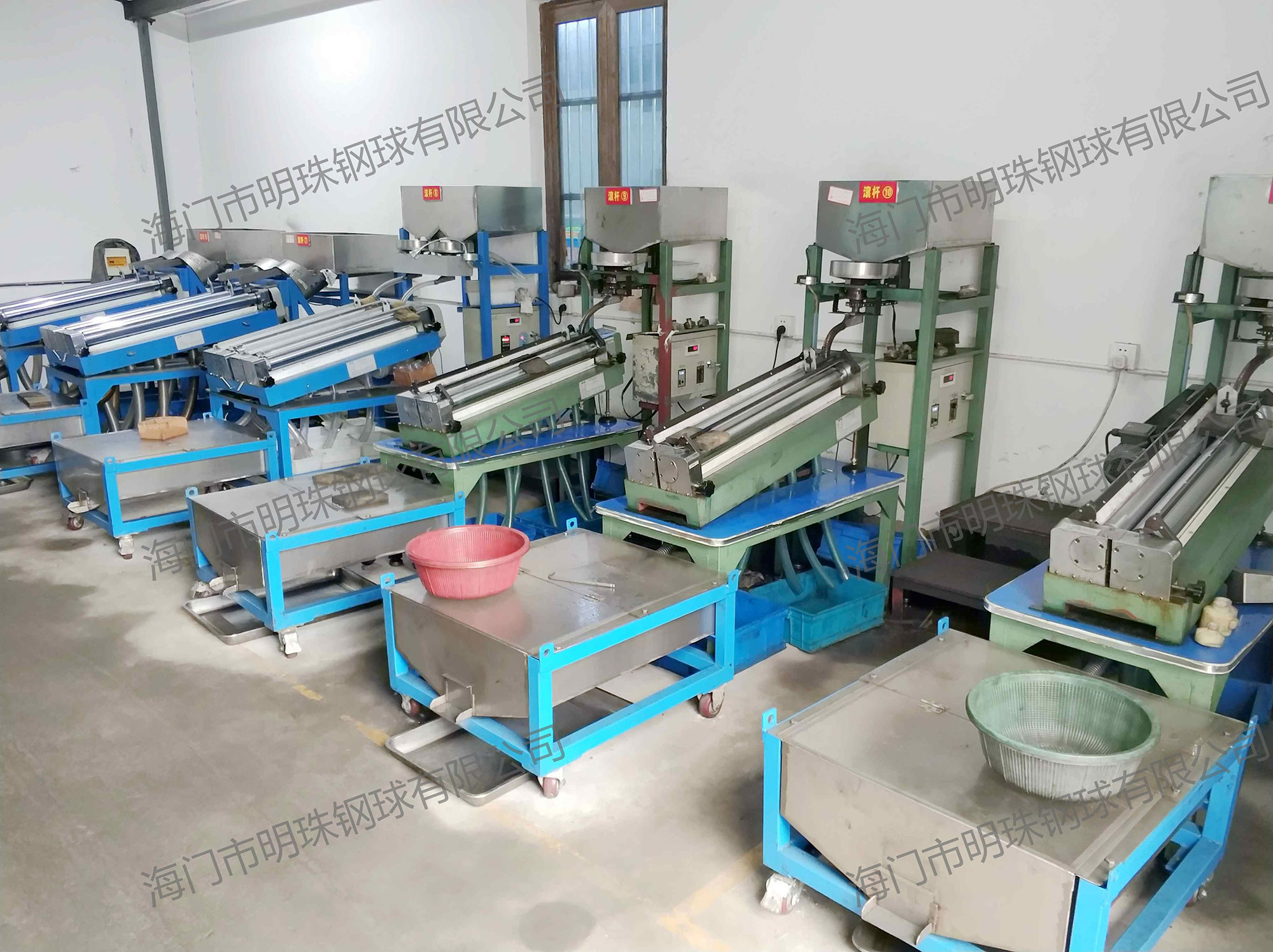
Roller-bar sorting equipment performs automated screening so that defective balls are removed before shipment.
Use Cases: Matching Balls to Valve Types
Floating and Trunnion-Mounted Ball Valves
In floating and trunnion-mounted ball valves, the ball is the primary shut-off surface. The ball rotates a quarter-turn to seal against upstream and downstream seats, so both hardness and surface finish matter. For petrochemical hydrocarbon service in the 0 °C to 200 °C window, hardened martensitic stainless — typically 420C in the HRC 48–55 range — provides the wear-resistant, moderately corrosion-resistant surface the seat needs. Where the ball must also carry a drilled passage, a machined drilled ball to drawing is used.
Check Valves
In check valves, the ball is a spring-loaded element that lifts under forward flow and drops back to seal against backflow. Because the ball reseats repeatedly and must seal immediately, hardness and true roundness are the two critical properties. A hardened 420C or 440C ball holds its sealing contact geometry over many cycles. In mildly corrosive or wet-gas service, the same hardened grade with moderate corrosion resistance prevents pitting on the sealing line.
Needle Valves
Needle valves meter flow precisely, and the ball is part of a fine control mechanism. Here precision grade matters as much as hardness. A G10 or G25 precision stainless steel ball reduces diameter variation so the metering curve stays repeatable. For mildly corrosive chemical streams, 420C or 316 provides the balance of hardness or corrosion resistance the trim requires.
Valve Service in Sour and Severe Chemical Duty
Where chlorides are high or the fluid is strongly acidic, the selection moves beyond 316-class materials. Duplex 2205 balls offer roughly double the yield strength of 316 with PREN around 34–38, suited to high-pressure and aggressive chemical service. For strong reducing acids and aggressive chemicals, Hastelloy C-276 provides resistance that 316 cannot. In sour service, NACE MR0175 may be specified and the supplier should confirm material compliance and provide supporting documentation.
Comparison Table: Valve Ball Materials at a Glance
| Material | Typical Hardness | Corrosion Resistance | Valve / Fluid Fit | Key Consideration |
|---|---|---|---|---|
| 420C (UNS S42000) — martensitic stainless | HRC ~48–55 | Moderate | Check and needle valves in mildly corrosive fluids; petrochemical hydrocarbon and wet gas | Requires heat-treatment control and passivation; balanced hardness vs corrosion |
| 440C (UNS S44004) — martensitic stainless | HRC 58–65 | Good | High-precision valves and bearings; wet, washdown and mildly corrosive duty | Higher processing cost; needs controlled hardening and passivation |
| 304 — austenitic stainless | ~HRB 80 (non-hardenable) | Good general (PREN ~18–20) | Corrosion-critical, low-wear service: food, pharma, decorative | Softer; not suitable for high-load sealing edges |
| 316 / 316L — austenitic stainless | ~HRB 85–95 (non-hardenable) | Excellent chloride (PREN ~23–28; 2–3% Mo, 10–14% Ni) | Marine, coastal, seawater, chemical and CIP/pharma service | Hardness is secondary; choose for corrosion, not load |
| Duplex 2205 (UNS S31803 / S32205) | Yield strength ~2× 316 | High (PREN ~34–38) | Offshore, subsea, high-pressure valves, desalination, aggressive chemical | Higher alloy and processing cost; needs controlled heat treatment |
| Hastelloy C-276 (UNS N10276) | High-alloy superalloy | Exceptional (PREN ~69; 15–17% Mo + 3–4.5% W) | Strong acids, aggressive chemicals, sour and severe-corrosion valve service | Very high material cost (roughly 5–12× 316); requires PMI/MTR verification |
| 52100 chrome steel (AISI 52100 / SUJ2) | HRC 60–66 | Low — needs protective lubrication | Maximum fatigue life in clean, protected bearing environments | Rusts in wet or corrosive service; not first choice for valve trim |
| M50 (UNS T11350, AMS 6490) | HRC 62–66 with high hot hardness | Moderate | Aerospace engine main-shaft bearings; high-temperature and high-speed spindles | Higher material and processing cost; needs AMS traceability |
Hardness, PREN and alloy content values above are drawn from the supplier's published material comparison data and applicable standards references (ISO 3290-1:2014, ASTM A295). Selection should always be confirmed against the specific fluid, temperature and pressure class of the valve.
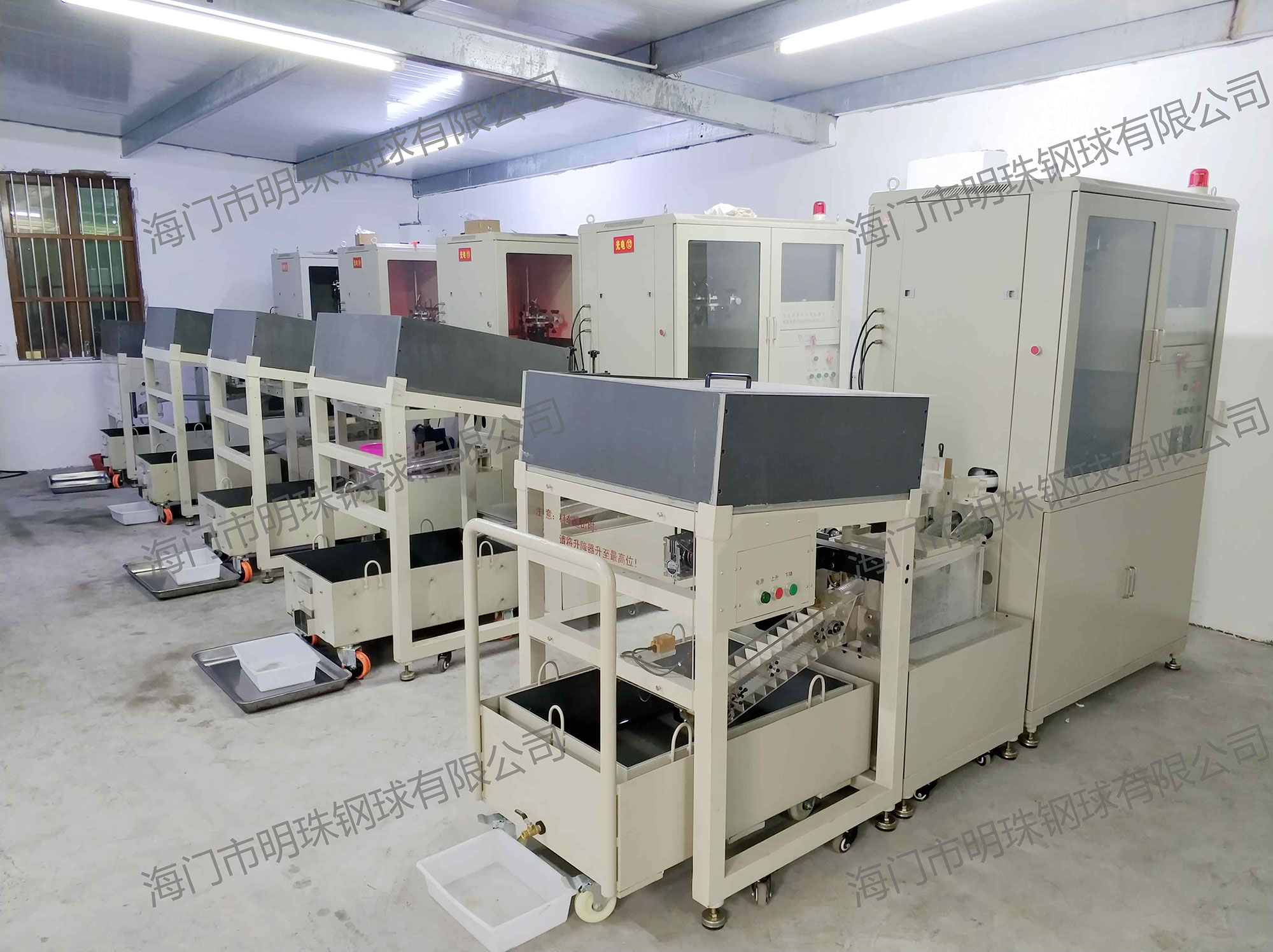
Automated defect detection screens surface and dimensional defects before finished balls are packed for shipment.
Long-Term Supply: Batch Traceability Beyond the First Order
Valve manufacturers rarely buy a valve-trim ball once. They buy it in repeat batches that must match the original specification for years. That makes supplier selection a systems decision as much as a materials decision.
Three supply-system capabilities matter for valve and petrochemical customers building annual programmes:
- Batch traceability. Material test reports to EN 10204 2.1 or 3.1 and certificates of analysis are provided with shipment, with PMI and hardness/surface reports available on request, so each batch can be matched back to its material record.
- Stable lead times. Standard precision grades are typically delivered in 10–30 days; standard stock sizes in 7–20 days; custom or non-standard balls usually take 20–50 days depending on drawing, material and quantity. Long-term supply orders are commonly shipped EXW or FOB, with FOB, CIF and DAP terms available.
- Flexible commercial terms. Standard payment is T/T 30/70, with L/C at sight for large orders, PayPal for samples, and open account (OA) or Net-30 terms negotiable for qualified repeat buyers and established accounts.
Haimen City Mingzhu Steel Ball Co., Ltd. is a China-based manufacturer founded in 1992 and located in Haimen, Jiangsu Province. The company operates a 7,500 m² production base with 40 employees and 8 engineers, running a stable annual production capacity of 2,500 tons and exporting about 25% of output to markets including the United States, Germany and Brazil. It holds the IATF 16949:2016 automotive quality management system certificate, and its core product line covers chrome steel balls and stainless steel balls manufactured in accordance with ISO, DIN, JIS and AISI standards, in precision grades from G10 to G500 and a size range from 2.0 mm to 50 mm. Beyond standard sizes, the company produces non-standard and custom parts, including drilled, threaded, hollow and electroplated balls, with CNC precision machining and hole drilling as supporting processes. Full-process inspection covers raw material sampling, automated roller-bar sorting and photoelectric surface defect detection before shipping. Learn more at www.hmmzsteelball.com.
Frequently Asked Questions
1. Can you provide batch traceability and material certification for valve-trim steel balls?
Yes. Material test reports to EN 10204 2.1 or 3.1 and certificates of analysis are provided with each shipment, supporting batch traceability for repeat orders and long-term supply contracts. Positive Material Identification (PMI), hardness reports and salt-spray (neutral) reports are available on request. For specialty alloy products, acceptance can include MTR EN 10204 3.1 and PMI for batch traceability, and for aerospace-grade products the acceptance routine can include hardness HRC testing, high-temperature and dimensional/roundness checks, MTR/AMS 6490 traceability, PMI and 100% inspection.
2. Can you supply hardened martensitic stainless balls at HRC 48–55 for valve service?
Yes. 420C martensitic stainless balls are hardened to approximately HRC 48–55 with moderate corrosion resistance, which matches the working profile of check valve and needle valve trim in wet gas and mildly corrosive fluids at 0 °C to 200 °C under moderate pressure. For higher hardness, 440C reaches HRC 58–65 with good corrosion resistance, and M50 reaches HRC 62–66 with high-temperature stability. Hardness, heat-treatment condition and microstructure are controlled by batch and reported on the material test report.
3. What are the payment terms and delivery terms for annual valve-programme supply?
Payment terms are T/T 30% deposit plus 70% balance before shipment as standard, L/C at sight for large orders, and PayPal or Western Union for sample fees. Open account (OA) or Net-30 terms are negotiable for qualified repeat buyers and established accounts, supporting long-term supply agreements. Standard delivery terms are EXW and FOB (Shanghai, Ningbo), with FOB, CIF and DAP also available. Small and non-standard batches are typically quoted as MOQ from 100 pcs, with samples and small batches welcomed.
4. Can I request sample balls before committing to a valve-trim order?
Yes. Samples are available, and small / prototype quantities of 10–50 pcs are workable for simple parts, with non-standard or CNC-machined balls typically starting from 50–500 pcs depending on setup. Sample fees are handled via PayPal or Western Union, and MOQ is flexible for first-time cooperation and NDA projects. For valve qualification, samples can be supplied with a hardness and surface report on request so the user can verify the grade before volume production.
5. What is the lead time and how do you keep supply stable over a year?
Standard precision grades are normally delivered within 10–30 days, with G3/G5 ultra-precision grades taking 25–50 days. Standard stock sizes ship in 7–20 days, and non-standard or special alloy balls generally require 20–50 days depending on drawing, material and quantity. Rolling stock and backup tooling are maintained to support stable repeat supply, and monthly production status updates are provided to help valve manufacturers plan against their own assembly schedules. For a quotation or a sample request tied to a specific check valve or needle valve programme, contact Haimen City Mingzhu Steel Ball Co., Ltd. directly with your ball drawing, material grade and annual estimated volume.
Conclusion
Steel ball selection for check valves and needle valves comes down to matching three parameters — hardness, corrosion resistance and operating temperature — to the specific valve function and fluid. For petrochemical trim in wet gas and mildly corrosive service between 0 °C and 200 °C, hardened martensitic stainless such as 420C at HRC 48–55 is the balanced engineering choice. When wear resistance dominates, step up to 440C. When chlorides and acids dominate, move to 316, duplex 2205 or Hastelloy C-276. When temperature rises beyond conventional valve-trim limits, M50 high-speed tool steel enters the picture.
Precision grade, geometry and documentation are the supporting disciplines that turn a correctly chosen material into a reliably sealing component. And because valves are built to programmes, not one-off orders, the supplier's batch traceability, lead-time stability and commercial flexibility matter as much as the ball itself.
For engineers specifying valve trim, the practical next step is to prepare the ball drawing and fluid/temperature data, request matched samples, and confirm the material and inspection documentation the programme will require. A technical brochure with the full product range and material options is available for download below.
Ready to Specify Valve-Trim Steel Balls?
Send your ball drawing, material grade, precision grade and annual volume estimate. Request samples, a technical quotation, or the full product brochure — including 420C, 440C, 304/316, duplex 2205, M50 and Hastelloy balls, plus drilled, hollow, electroplated and non-standard custom parts.
Download Product Brochure Request a QuoteHaimen City Mingzhu Steel Ball Co., Ltd. — No. 718 West Renmin Road, Haimen City, Jiangsu Province, China. Email: info@hmmzsteelball.com. Tel / WhatsApp: +86 13912237934.
Have Questions or Need More Details?
Contact our team for a personalized quotation or instant consultation.
Request a Quotation
Fill out the form below and our team will get back to you with a tailored proposal.
WhatsApp Direct Chat
Prefer to chat in real-time? Message us on WhatsApp for instant assistance & quick answers.
- Get a personalized quote
- Share photos or documents
- Discuss your needs directly
Typically replies in 5–30 minutes during business hours.