
Steel Balls for EV Powertrain and Wheel-Hub Bearings: Application Guide
Application Guide · Automotive & EV Bearing Components
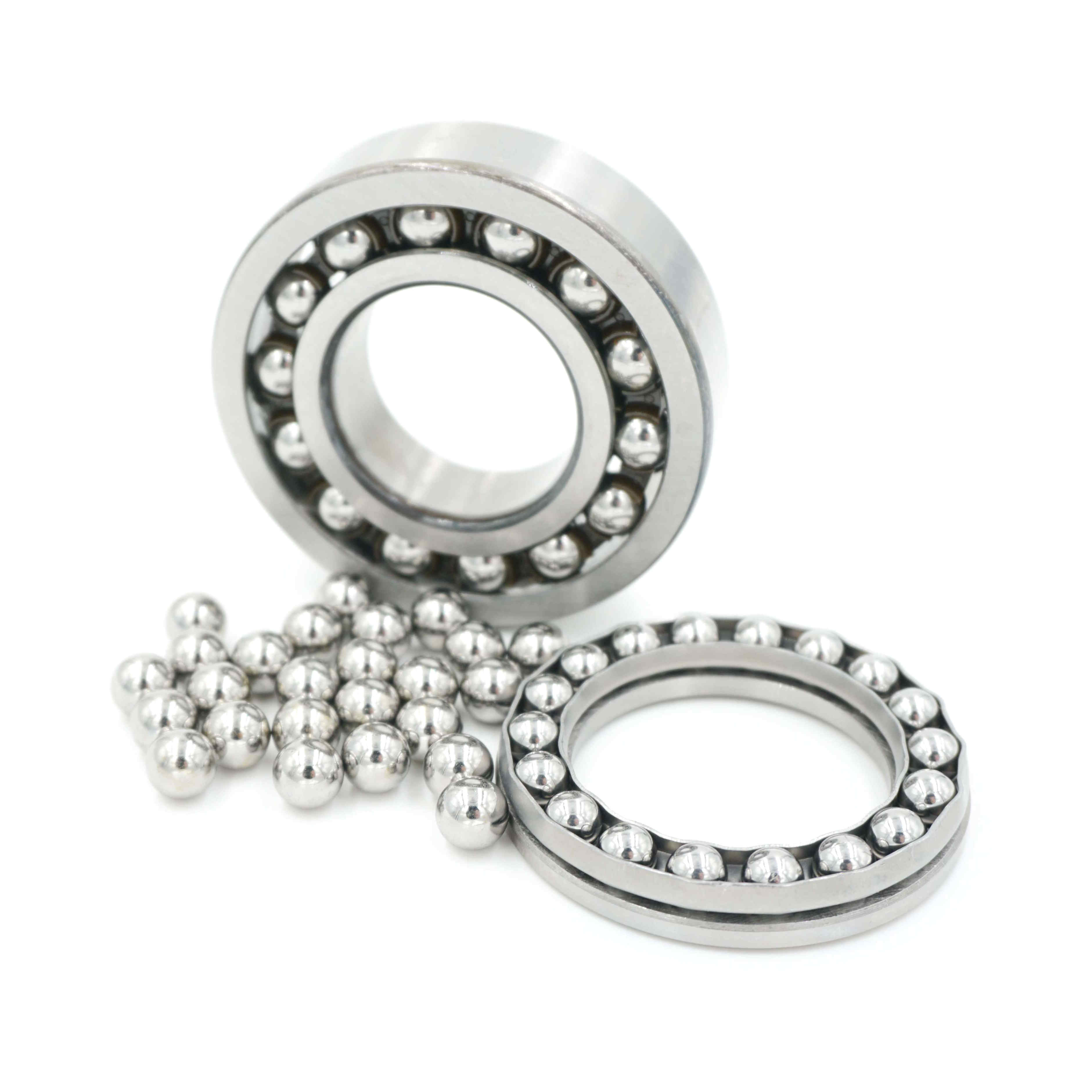
Chrome steel balls produced to AISI 52100 / DIN 100Cr6 / JIS SUJ2 for bearing-grade applications.
Steel balls are the rolling media inside the wheel-hub, transmission and e-axle reduction-gear bearings that carry a vehicle’s rotating loads. In an electric drivetrain these balls run at high speed inside bearings lubricated by an oil bath or by oil splash, must hold a consistent diameter across the production lot, and must demonstrate a fatigue life that matches the duty cycle the vehicle programme has specified.
This guide is written for bearing engineers, powertrain buyers and sourcing teams who need to convert a drivetrain requirement into a ball specification: which material, which hardness, which precision grade, which diameter consistency, and which quality documents an automotive programme will ask for. The adjacent geometries that appear around the same bearing assemblies — precision, non-standard, drilled, hollow, machined and electroplated steel balls — are covered in the same framework.
Haimen City Mingzhu Steel Ball Co., Ltd. is a China-based manufacturer, founded in 1992, that specialises in the research, development and production of high-precision steel balls. Its core products are bearing steel balls and chrome steel balls, supported by stainless steel balls, carbon steel balls, machined steel balls, non-standard steel balls, precision steel balls, drilled steel balls, electroplated steel balls, hollow steel balls, duplex stainless steel balls, M50 steel balls and Hastelloy steel balls. The company holds an IATF 16949:2016 quality management system certificate for the automotive industry.
Short answer: for EV powertrain and wheel-hub bearing positions, through-hardened bearing steel balls in AISI 52100 / SUJ2 (100Cr6) are the standard selection. They are supplied from 0.5 mm to 50.8 mm (1/64"–2"), in precision grades G10–G1000, at HRC 60–66 and Ra ≤ 0.05 µm. Martensitic stainless 440C (HRC 58–62) and 420C (HRC 50–55) cover bearing positions exposed to moisture or wash-down, while carbon steel balls remain suitable for lower-load, non-critical positions rather than high-speed EV bearing duty.
Problem Definition: Why EV Duty Redefines Steel Ball Requirements
Bearing balls do not change because a vehicle is electric. They change because the bearing around them is asked to do a different job. The automotive and EV powertrain application profile recorded for these positions is a high-RPM, oil-lubricated bearing operating through a temperature swing of roughly −20 °C to 150 °C, where wheel-hub bearings, transmission bearings and e-axle reduction gears rely on steel balls as critical rolling media under high-speed rotary operation with oil bath or splash lubrication.
That environment translates into five specification pressures that a buyer should be able to name before requesting a quotation.
- Fatigue life rating. A ball that supports a continuously rotating shaft accumulates far more load cycles than one in intermittent duty. Fatigue life is the first performance parameter to agree with the bearing designer, because it determines the steel quality and heat-treatment condition rather than the geometry alone.
- Consistent ball diameter. Ball-to-ball diameter variation directly influences internal clearance, preload and the load distribution across the ball set. A lot that is nominally within grade but inconsistent in diameter distribution can shift bearing behaviour from one assembly to the next.
- Roundness, waviness and surface finish. These control running noise and vibration at speed. Precision grades exist precisely to make roundness, diameter variation, waviness and surface finish reportable rather than assumed.
- Traceability for OEM programmes. Automotive customers expect lot identification, material verification and heat-treatment records that can be followed back to the raw material batch. This is the reason the IATF 16949:2016 framework exists in the supply chain.
- Lubrication and geometry. Balls for a wheel-hub position and balls for a transmission bearing may share a material grade but not a size or a grade tolerance, so the specification has to be set position by position rather than by product family.
Industry Background: Market, Standards and Material Mix
Steel ball demand tracks the wider bearing and industrial equipment market, and the published market figures for 2026 show a category that is still growing in absolute value.
- The global steel ball market is estimated to reach USD 12.91 billion by 2026 (Coherent Market Insights).
- Chrome steel balls are projected to hold a 45.7% market share by 2026, leading the material segment (Coherent Market Insights).
- A projected CAGR of 5.2% for 2026–2035 has been published by Business Research Insights; other research houses publish figures such as 3.6% and 6.2%, with the difference attributed to whether large grinding media or precision bearing balls dominate the sample.
Three standards shape how these products are specified and traded, and all three appear in normal automotive bearing ball documentation.
- ISO 3290-1:2014 specifies requirements for finished steel balls for rolling bearings and defines grades from G3 to G700. This is the common vocabulary behind terms such as “G10” or “G25”.
- ASTM A295/A295M covers high-carbon anti-friction bearing steel, including Grade 52100 — the material that appears in most wheel-hub, transmission and electric motor bearings.
- HS code 8482.91 classifies balls, needles and rollers for bearings, which is the code under which precision balls normally cross borders.
For an EV programme the practical consequence is that a ball supplier is evaluated less on catalogue breadth and more on whether the same grade, the same inspection method and the same documentation can be repeated lot after lot for several years.
Detailed Solution: Matching Steel Ball Specifications to EV Bearing Positions
Bearing and chrome steel balls: the default for drive-side positions
Bearing steel balls are through-hardened chrome alloy steel balls made from AISI 52100 / SUJ2 (100Cr6). They are supplied from 0.5 mm to 50.8 mm (1/64"–2") in precision grades G10–G1000, at HRC 60–66 with surface roughness Ra ≤ 0.05 µm. The published application list for this product covers ball bearings, automotive wheel hubs, electric motors, precision spindles and aerospace control systems, which is essentially the list of positions an EV drivetrain is built from.
Chrome steel balls use the same material family — AISI 52100 / DIN 100Cr6 / JIS SUJ2 — from 1 mm to 50.8 mm in grades G10–G1000 at HRC 60–66, with an isotropic finish available. The published application list names anti-friction bearings, automotive transmissions, precision instruments and valve train components. For a transmission or e-axle bearing, the meaningful parameter is not the grade label alone but the combination of hardness, dimensional stability and a surface finish that can survive continuous rotation in oil.
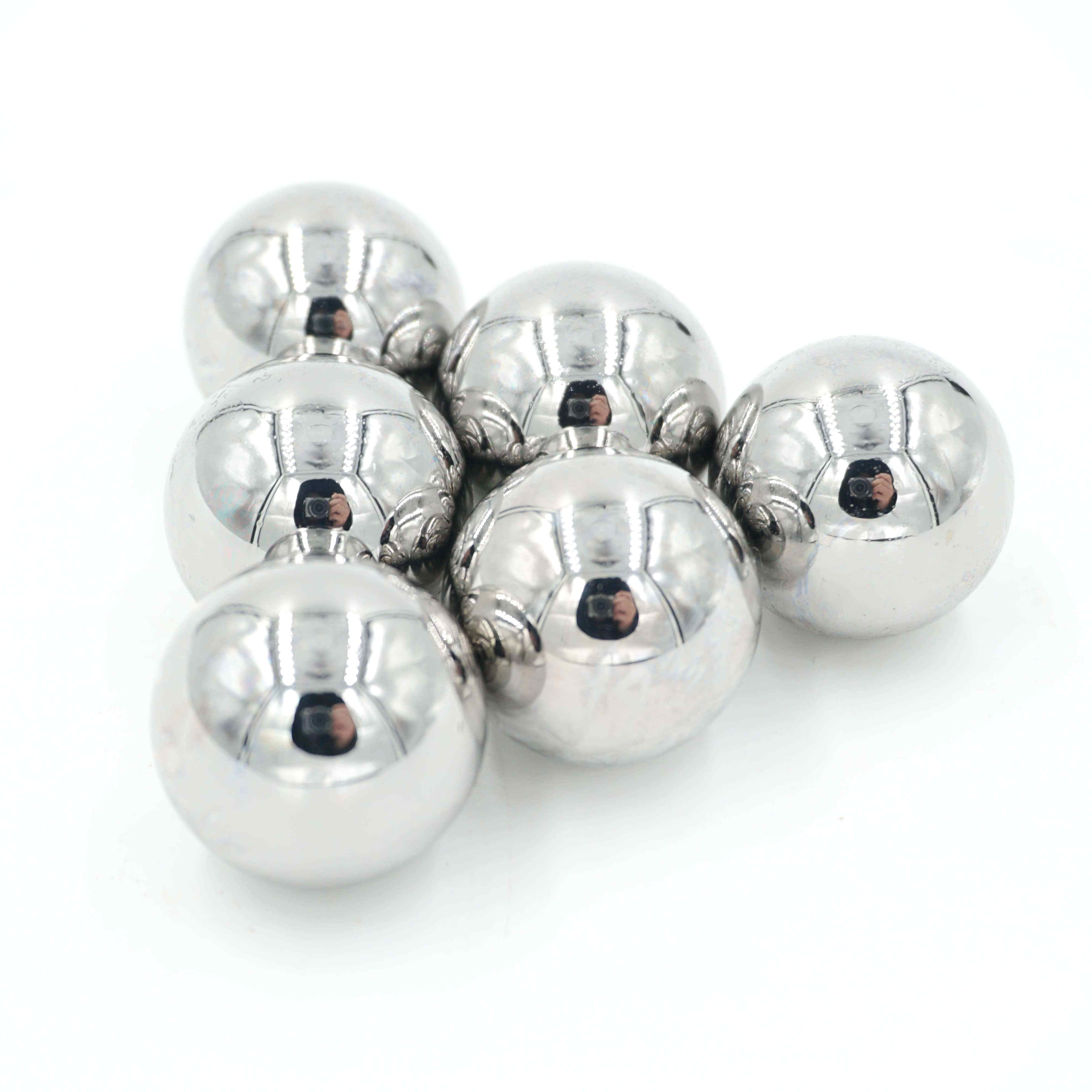
Through-hardened bearing steel balls, G10–G1000, HRC 60–66, Ra ≤ 0.05 µm.
Martensitic stainless 440C and 420C for moisture-exposed positions
Not every bearing in a vehicle sits inside an oil bath. Where a ball position sees condensation, wash-down or mild process fluids, martensitic stainless grades deliver hardness and corrosion resistance together.
- 440C Stainless Steel Ball — AISI 440C / UNS S44004, martensitic stainless precision ball, 0.5–50.8 mm, grades G10–G1000, HRC 58–62, maximum 0.07% P/S. Its recorded applications include high-precision bearings, aerospace actuators and chemical pumps.
- 420C Stainless Steel Ball — AISI 420C / UNS S42000, martensitic stainless precision ball, 1–50.8 mm, grades G25–G1000, HRC 50–55. It is intended for bearings in mildly corrosive environments and for wash-down and humid-duty bearing assemblies.
The selection rule is straightforward: if the position is dry, oil-lubricated and load-critical, chrome or bearing steel is the higher-performing choice; if the position is exposed to moisture, 440C or 420C removes the corrosion risk at a modest hardness cost.
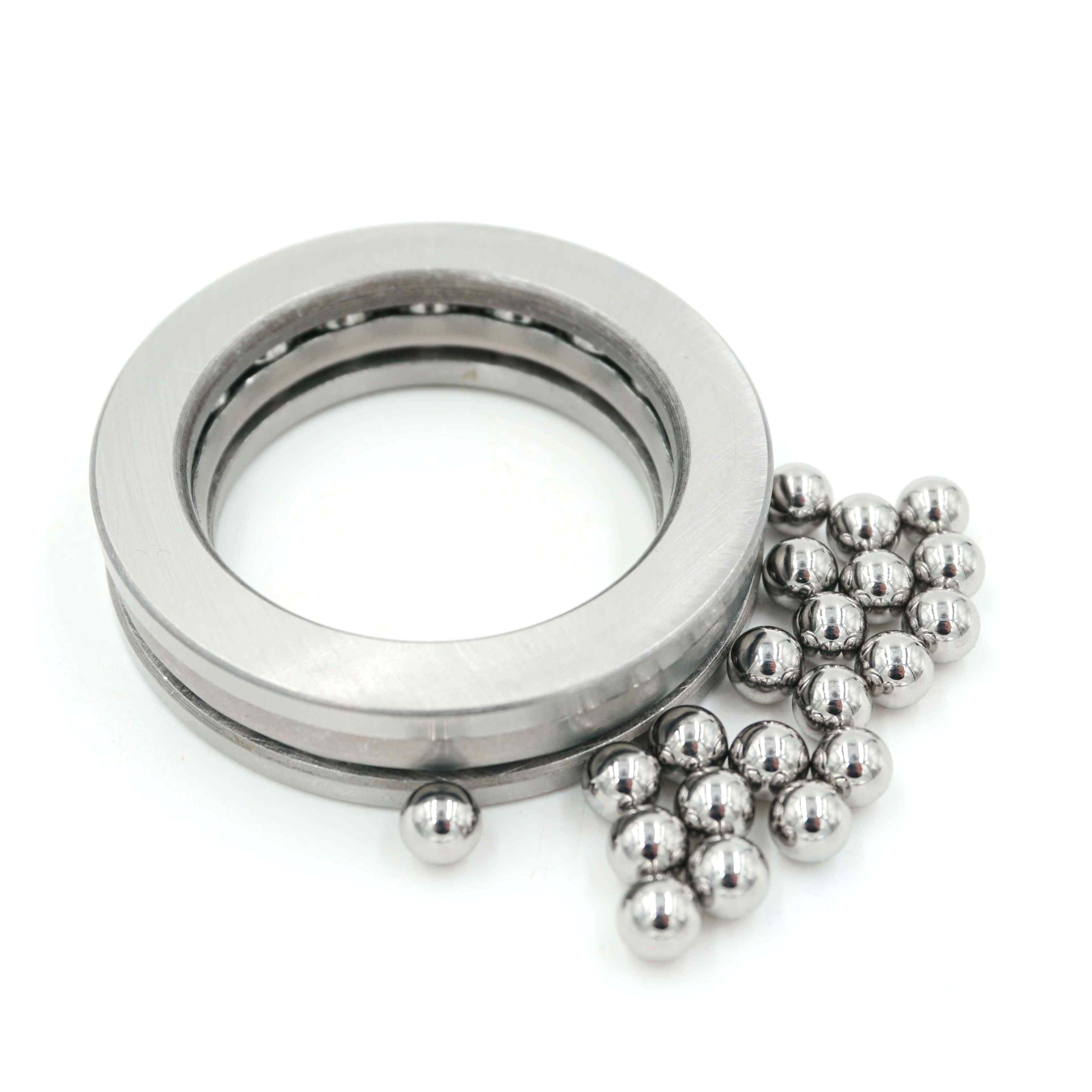
440C martensitic stainless balls, HRC 58–62, for bearing applications requiring corrosion resistance.
Precision grades: where diameter consistency is actually controlled
Precision steel balls are the product line that carries the tightest dimensional control: 0.5–50.8 mm in grades G3, G5, G10, G16 and G25, with sphericity held within micro-inches. Materials available in this line include 52100, 100Cr6, 420C, 440C, 316 and 304. The recorded applications are precision bearings, high-speed spindles, metrology and measuring instruments, and aerospace gyroscopes.
In practice, a powertrain bearing programme does not need G3 everywhere. The requirement should be set position by position: a wheel-hub bearing and an e-axle reduction-gear bearing may both run in the G10–G25 band, while a non-critical auxiliary position can be satisfied by G100–G1000 stock product. Specifying tighter than the bearing design requires increases cost without improving vehicle performance.
Carbon steel balls: correct duty, real limits
Carbon steel balls are produced from 1010, 1015 and 1018 carbon steel and are available in unhardened or through-hardened condition, from 1 mm to 50.8 mm, in grades G100–G2000, with hardness up to HRC 55–60 when hardened. The recorded applications are automotive steering and suspension, bicycle and caster bearings, conveyor rollers, grinding media and low-cost hardware.
This is a useful family for high-volume, cost-driven positions. It is not the right family for a wheel-hub or e-axle bearing, where the load and speed duty calls for through-hardened chrome alloy steel in the HRC 60–66 range.
M50 and other high-speed options
Where a bearing combines very high speed with elevated temperature, M50 steel balls (AISI M50 / UNS T11350, AMS 6490) retain high hot hardness and dimensional stability, typically 3–50 mm at HRC 62–66. Their documented use is aerospace engine main-shaft bearings and high-speed turbomachinery — a useful reference point when a powertrain application pushes conventional bearing steel close to its thermal limit.
Inspection, documentation and OEM traceability
Traceability is the requirement most often under-specified at the quotation stage and most often audited later. A workable package has two halves.
- Inspection. Every batch passes 100% automated machine-vision sorting for size, roundness, surface defects and appearance, supplemented by hardness, roundness, microstructure, roughness and material verification (PMI / chemical analysis).
- Documentation. Material test report (MTR), EN 10204 2.1 / 3.1, COA, and on request PPAP, FAI, NACE MR0175 and AMS certificates.
Haimen City Mingzhu Steel Ball Co., Ltd. operates a 7,500 m² production base with 105 sets of processing and production equipment, an annual production capacity of 2,500 tons, approximately 40 staff and an R&D team of 8 engineers, and holds the IATF 16949:2016 certificate that automotive programmes normally require before a supplier is added to a bill of materials. Products are manufactured in accordance with mainstream international standards including ISO, DIN, JIS and AISI.
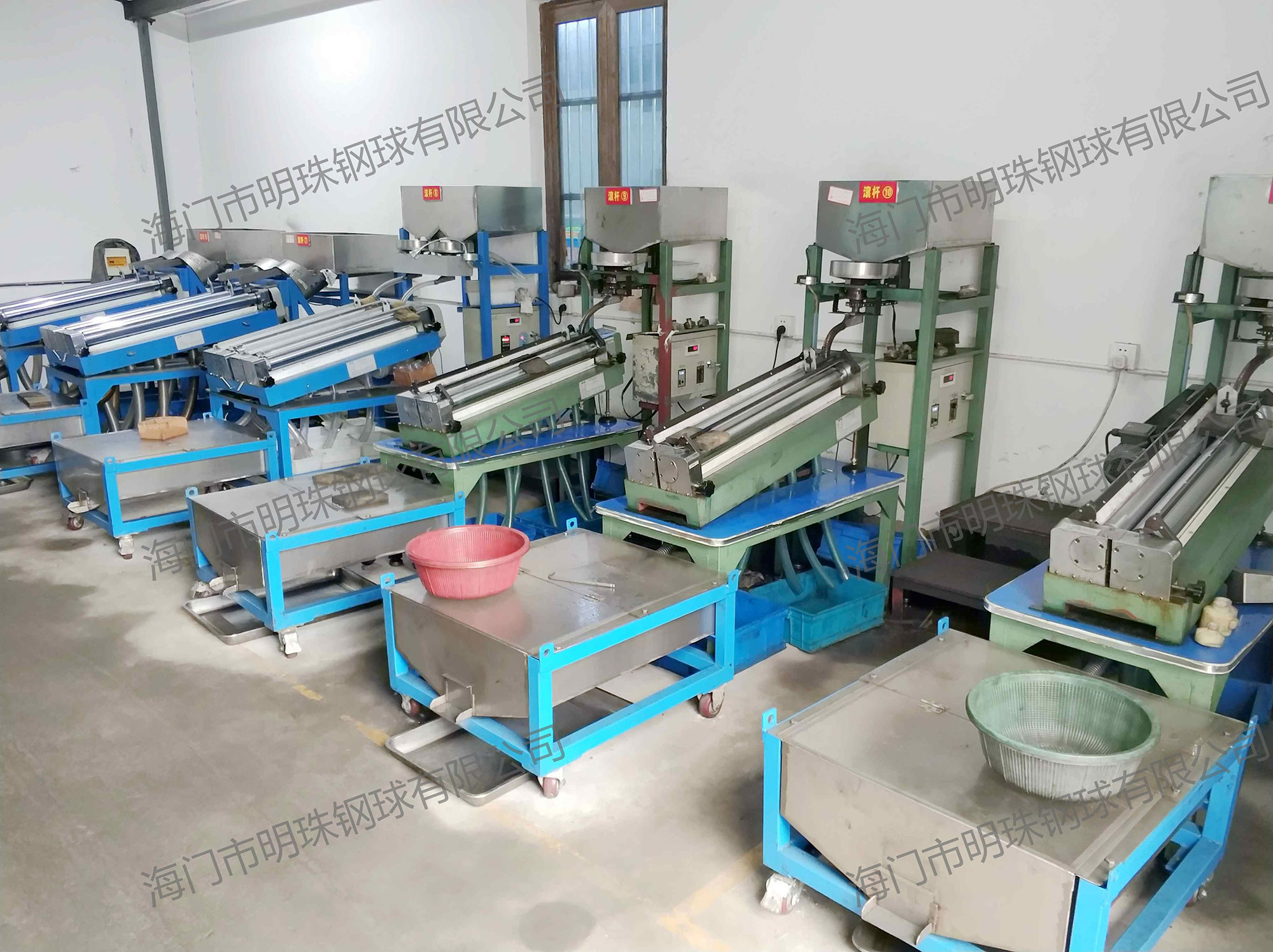
Roller bar sorting equipment used for automated size and defect screening of every batch.
Step-by-Step Breakdown: Specifying a Ball for a Wheel-Hub or E-Axle Bearing Programme
The sequence below reflects how a ball specification is normally closed out between a bearing engineer and a steel ball manufacturer.
- Define the bearing position and duty cycle. State whether the position is a wheel-hub bearing, a transmission bearing or an e-axle reduction-gear bearing, and record speed, load direction and lubrication. EV powertrain positions are typically specified as high RPM, oil-lubricated, −20 °C to 150 °C.
- Fix material and hardness. Select the material family first — bearing or chrome steel for dry, oil-lubricated drive positions; 440C or 420C where moisture or mild corrosion is present; carbon steel only for lower-load, non-critical positions. Hardness follows: HRC 60–66 for 52100-family steel, HRC 58–62 for 440C, HRC 50–55 for 420C.
- Choose the diameter and precision grade. Diameters from 0.5 mm to 50.8 mm are available in metric and inch series, with non-standard decimal sizes produced to drawing. Grades run from G3 to G1000 against ISO 3290 / ABMA nomenclature; common stock is G100–G1000 and precision work sits in G10–G25.
- Specify diameter consistency and roundness controls. Ask for roundness, diameter variation, waviness and surface finish to be reported by grade rather than described qualitatively. This is the parameter set that protects preload, clearance and NVH behaviour in the assembled bearing.
- Agree the inspection and documentation package. Confirm 100% automated sorting, and confirm which documents travel with the shipment: MTR, EN 10204 3.1, COA, and whether PPAP or FAI is required for the programme.
- Validate with samples or a first article. Prototype or first-article samples can be supplied before mass production approval, which allows the ball to be proven in the actual bearing assembly before tooling and volume commitments are made.
- Plan supply continuity and commercial terms. Stock sizes ship in 5–10 days, standard production runs 15–30 days, and non-standard or CNC-featured parts take 20–60 days depending on tooling and inspection. Packaging can be supplied as drums, sealed bags, tubes or blisters and OEM-labelled cartons, marked with quantity, grade and lot code.
Use Cases: Three EV Positions and One Adjacent One
Wheel-hub bearings
A wheel-hub bearing carries vehicle weight plus cornering and braking loads, and it rotates continuously for the life of the vehicle. The ball requirement here is a through-hardened chrome alloy ball in the 52100 family, HRC 60–66, Ra ≤ 0.05 µm, supplied as a consistent set so that preload and clearance stay inside the design window. Bearing steel balls are explicitly listed for automotive wheel-hub applications, which is why this position is usually the first one qualified in a new programme.
Transmission bearings
Transmission bearings in an EV operate at high speed under oil bath or splash lubrication. Chrome steel balls are listed for automotive transmissions and anti-friction bearings, and the combination of HRC 60–66 hardness with dimensional stability is what allows the bearing to hold its geometry across the temperature range. Where running noise matters, an isotropic finish option and a tighter precision grade are the two specification levers available.
E-axle reduction gears
The bearings supporting an e-axle reduction gear set combine radial and axial load at high rotational speed, and they sit in the same oil circuit as the gear mesh. The documented requirement profile for this application is a consistent ball diameter, a fatigue life rating and IATF 16949 traceability — three items that should appear in the purchase specification, not only in the supplier audit.
Corrosion-exposed and auxiliary positions
Outside the oil circuit, bearings in wash-down or humid areas are better served by 420C (HRC 50–55, G25–G1000) for mildly corrosive duty or 440C (HRC 58–62, G10–G1000) where hardness and corrosion resistance are both needed. Where a coated ball is required for low-corrosion indoor use or conductivity-critical parts, electroplated steel balls are available with zinc, nickel or chrome coatings, with plating thickness specified per order — for example zinc at 5–25 µm. Austenitic 304 and 316 stainless balls remain a corrosion-first choice rather than a load-bearing one, since they are supplied in the annealed soft condition.
Comparison Table: Bearing Ball Options for EV-Related Positions
The table below compares ball families that are actually specified around automotive and EV bearing assemblies. Figures are the manufacturer’s published product data.
| Ball type / material | Hardness | Diameter range | Precision grades | Typical automotive / EV position |
|---|---|---|---|---|
| Bearing Steel Ball — AISI 52100 / SUJ2 (100Cr6) | HRC 60–66 | 0.5–50.8 mm (1/64"–2") | G10–G1000 | Ball bearings, automotive wheel hubs, electric motors, precision spindles |
| Chrome Steel Ball — AISI 52100 / DIN 100Cr6 / JIS SUJ2 | HRC 60–66 | 1–50.8 mm | G10–G1000 | Anti-friction bearings, automotive transmissions, valve train components |
| 440C Stainless Steel Ball — AISI 440C / UNS S44004 | HRC 58–62 | 0.5–50.8 mm | G10–G1000 | High-precision bearings where corrosion resistance is also required |
| 420C Stainless Steel Ball — AISI 420C / UNS S42000 | HRC 50–55 | 1–50.8 mm | G25–G1000 | Bearings in mildly corrosive, wash-down and humid-duty assemblies |
| Precision Steel Ball (52100 / 100Cr6 / 420C / 440C / 316 / 304) | Depends on selected material | 0.5–50.8 mm | G3 / G5 / G10 / G16 / G25 | Precision bearings, high-speed spindles, metrology instruments |
| Carbon Steel Ball — 1010 / 1015 / 1018 | Soft as supplied, or HRC 55–60 hardened | 1–50.8 mm | G100–G2000 | Automotive steering and suspension, casters, conveyor rollers, low-cost hardware |
| M50 Steel Ball — AISI M50 / UNS T11350 (AMS 6490) | HRC 62–66 | 3–50 mm typical | Per aerospace specification | High-temperature, high-speed bearing and turbomachinery applications |
A second, shorter table maps the four positions discussed above to the ball family that should be evaluated first.
| Bearing position | Ball family to evaluate | Key requirement to write into the specification |
|---|---|---|
| Wheel-hub bearing | Bearing Steel Ball (AISI 52100 / SUJ2) | Through-hardened HRC 60–66, G10–G1000, Ra ≤ 0.05 µm, consistent diameter across the lot |
| Transmission bearing | Chrome Steel Ball (AISI 52100 / DIN 100Cr6 / JIS SUJ2) | HRC 60–66, 1–50.8 mm, isotropic finish option, dimensional stability at temperature |
| E-axle reduction-gear bearing | Bearing / precision steel ball | Consistent ball diameter, fatigue life rating, IATF 16949 traceability |
| Moisture or wash-down exposed position | 420C or 440C stainless steel ball | HRC 50–55 or HRC 58–62, corrosion resistance confirmed by material certificate |
FAQ
What quality documents and traceability can be provided for an automotive OEM programme?
Every batch passes 100% automated machine-vision sorting for size, roundness, surface defects and appearance, supplemented by hardness, roundness, microstructure, roughness and material verification such as PMI or chemical analysis. The documents issued with shipments are the material test report (MTR), EN 10204 2.1 / 3.1 and COA; PPAP, FAI, NACE MR0175 and AMS certificates can be provided on request. The manufacturing system is certified to IATF 16949:2016.
Which ball materials and hardness levels suit EV powertrain and wheel-hub bearings?
Chrome steel 52100 is through-hardened to approximately HRC 60–66 and is the standard choice for wheel-hub, transmission and electric motor bearings. 440C martensitic stainless is supplied at HRC 58–62 where corrosion resistance is also required, and 420C at HRC 50–55 for mildly corrosive or wash-down duty. M50 reaches HRC 62–66 with high-temperature stability for the most severe high-speed applications. Hardness and heat-treatment condition are controlled by batch and reported on the MTR.
What diameter sizes and precision grades can be supplied?
Diameter range is typically 0.5–50.8 mm (0.020–2.000 in) in both metric and inch series, with non-standard decimal sizes produced to drawing. Precision grades follow ABMA / ISO 3290 from G3 to G1000; common stock covers G100–G1000 and precision production covers G10–G25. Roundness, diameter variation, waviness and surface finish are reported by grade.
What is the MOQ, and can samples be supplied before an OEM programme is approved?
Standard catalogue sizes have a low MOQ and can be ordered by the bag or piece, and samples are available. Non-standard and CNC-machined balls usually start from 50–500 pieces depending on setup, and prototype quantities of 10–50 pieces are workable for simple parts. Prototype or first-article samples can be supplied before mass production approval, and MOQ is flexible for first-time cooperation and NDA projects.
What lead time should an EV bearing programme plan for?
Standard sizes and common materials are often held in stock and can ship in 5–10 days. Standard production runs 15–30 days; non-standard sizes, special alloys or CNC features take 20–60 days depending on tooling and inspection. Rolling stock and backup tooling are maintained for stable repeat supply, with monthly production status updates. To move a programme forward, send the drawing or specification to info@hmmzsteelball.com for a sample or quotation.
Conclusion
Steel ball selection for EV powertrain and wheel-hub bearings is a short, repeatable exercise once the bearing position is defined. Wheel-hub and transmission positions point to through-hardened bearing or chrome steel in the 52100 family, HRC 60–66, Ra ≤ 0.05 µm, in grades from G10 to G1000. Moisture-exposed positions move the specification to 440C or 420C stainless. E-axle reduction-gear bearings add three requirements that are easy to leave out of a purchase order but hard to retrofit later: a consistent ball diameter, a stated fatigue life rating and IATF 16949 traceability.
Haimen City Mingzhu Steel Ball Co., Ltd. manufactures these product families from a 7,500 m² facility in Haimen, Jiangsu Province, China, with 105 sets of production equipment, a capacity of 2,500 tons per year and an R&D team of 8 engineers, serving markets including the United States, Germany and Brazil, with exports accounting for 25% of sales.
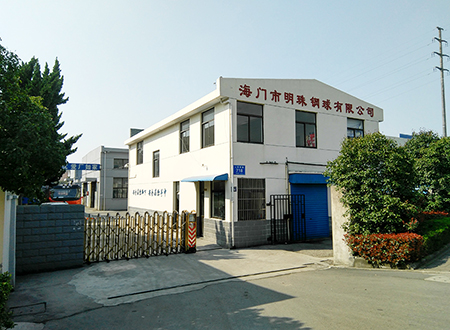
Steel ball manufacturing base in Haimen, Jiangsu Province, China.
Next Step: Sample, Drawing Review or Quotation
Send the bearing position, target grade and any drawing for a technical review, sample request or quotation. Non-standard, drilled, threaded and hollow geometries are quoted per drawing.
Email: info@hmmzsteelball.com · Tel / WhatsApp: +86 13912237934 · Website: www.hmmzsteelball.com
Product brochure (download): Haimen Mingzhu Steel Ball Brochure
Address: No. 718 West Renmin Road, Haimen City, Jiangsu Province, China.
Have Questions or Need More Details?
Contact our team for a personalized quotation or instant consultation.
Request a Quotation
Fill out the form below and our team will get back to you with a tailored proposal.
WhatsApp Direct Chat
Prefer to chat in real-time? Message us on WhatsApp for instant assistance & quick answers.
- Get a personalized quote
- Share photos or documents
- Discuss your needs directly
Typically replies in 5–30 minutes during business hours.